
Filipe Domingues
Director of The Lay Centre
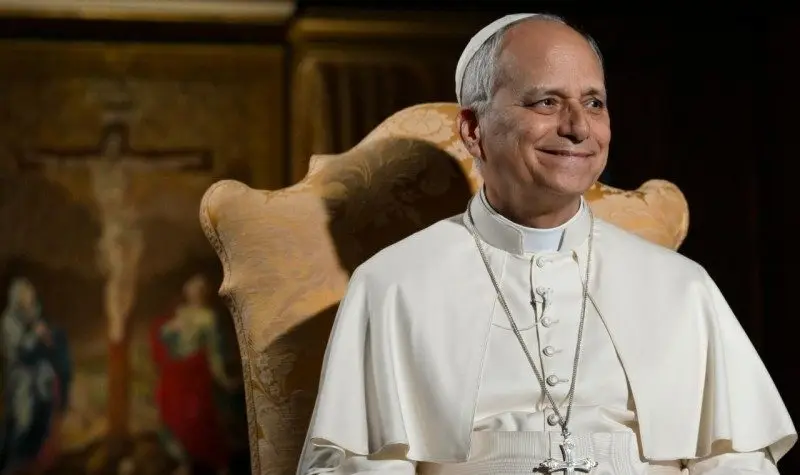
“Unarmed and disarming” is one of the expressions most frequently used by Pope Leo XIV since his election as Bishop of Rome and successor of the Apostle Peter, on May 8, 2025. Perhaps these words help us understand his first year of pontificate.
“Unarmed and disarming” is the peace we need to promote today, he declared in his first address: the true peace of the Risen Christ, “humble and persevering.” This is the peace that “comes from God, who loves everyone unconditionally.” We need our words to be “unarmed and disarming,” he told journalists and communicators. We need a “form of communication capable of listening, of giving a voice to the most vulnerable who have no voice.”
“Unarmed and disarming” is the model of education the world needs, he told students during the Jubilee of the World of Education. “It is not enough, in fact, to silence weapons: we must disarm hearts, renouncing all violence and vulgarity. In this way, a disarming and unarmed education creates equality and growth for all, recognizing the equal dignity of every young person, without ever dividing young people between the privileged few who have access to expensive schools and the many who do not have access to education.”
Perhaps Pope Leo’s own election was somewhat “unarmed and disarming:” on the one hand, it surprised many of those awaiting sensational news about the then American Cardinal Robert Francis Prevost, elected the 267th Pontiff after the widely acclaimed Pope Francis. On the other hand, even with his discreet, quiet style, attentive listening, and restrained smile, and in a certain sense “unarmed,” Leo XIV continues to “disarm” our expectations. He reveals himself each day, with every encounter, every word, and every gesture of his daily life.
Axes of the pontificate
Peace, unity, synodality, and interior life may be the four axes of his pontificate so far. Peace, which begins in hearts, he says, is not only the “absence of war,” as taught by Catholic Social Teaching.
“Goodness is disarming. Perhaps this is why God became a child. The mystery of the Incarnation, which reaches its deepest descent even to the realm of the dead, begins in the womb of a young mother and is revealed in the manger in Bethlehem. ‘Peace on earth,’ sing the angels, announcing the presence of a defenseless God, in whom humanity can only discover itself as loved only by caring for him (cf. Lk 2:13-14).”
Unity is something to be sought and built. “In the unity of faith, proclaimed since the beginning of the Church, Christians have been called to walk in harmony, guarding and transmitting the gift they have received with love and joy,” he said in the message for the 1,700th anniversary of the Council of Nicaea.
Synodality, in turn, is the path to be walked together. It does not have only one possible method but is a way of being Church.
“The gift of listening is something I think we all acknowledge, yet it has often been lost in certain sectors of the Church,” he said in a meeting with members of the Synod.
“We need to continue to discover how valuable it is, beginning with listening to the Word of God, to one another, and to the wisdom that we find in men and women, in members of the Church and also in those who are searching for the truth, even if they are not yet – or may never become – members of the Church.”
Interior life is something to be cultivated each day, in daily practice, in every activity placed in the presence of God, but also in silence and prayer.
“Although it is true that we must live out our faith through concrete actions, faithfully carrying out our duties according to our state of life and vocation, it is essential that we do so only after meditating on the Word of God and listening to what the Holy Spirit is saying to our hearts.”
To this end, he says, “we should set aside moments of silence, moments of prayer, times in which, quieting noise and distractions, we recollect ourselves before God in simplicity of heart,” he stated during a celebration in the Cathedral of Albano, on the outskirts of Rome.
Witness and prophecy
Pope Leo shows every sign of being a pope attentive to the world’s problems. An Augustinian missionary and experienced in pastoral life, especially during his years as a priest and bishop in Peru, he is in tune with the suffering of those who live in difficult situations.
His choice of the name Leo, as many observed and as he himself confirmed in his first meeting with the cardinals after the conclave, is a direct reference to Pope Leo XIII, author of the important social encyclical Rerum Novarum, and to the prophetic role of the Church, to proclaim and bear witness to the Gospel in the face of the world’s crises.
“In our own day, the Church offers to everyone the treasury of her social teaching in response to another industrial revolution and to developments in the field of artificial intelligence that pose new challenges for the defense of human dignity, justice, and labor,” he said in his first meeting with the cardinals after the election.
Everything indicates that his first encyclical, to be published soon, will open the way for these and other disarming teachings, which, with unarmed hearts, we are about to discover.
Photo: Vatican Media
Originally published in Portuguese at “O São Paulo” newspaper


