An Anglican priest reflects on a transformative ecumenical journey at The Lay Centre in Rome
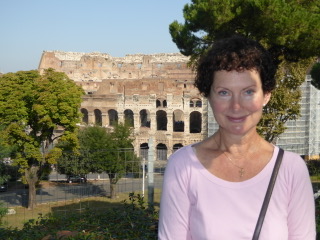
EXETER, UNITED KINGDOM – Ruth Frampton, ordained priest in the Exeter Diocese of England in 2015-2016, serves as the Rector of six village churches in the Teign Valley & Haldon Hill Mission Community and is the Rural Dean of the Kenn Deanery. Last year, she was appointed a prebendary canon of Exeter Cathedral. Her path to ministry has been shaped by unexpected moments of discernment and encounter; experiences she traces in part to her time in Rome. “Without the Lay Centre, I would never have experienced any of that,” she reflects. “I am profoundly grateful.” Her journey, enriched by her time at The Lay Centre, has been one of deepening faith, ecumenical engagement, and living in community.
As we prepare for our 40th anniversary in 2026–2027, The Lay Centre begins this series of alumni profiles.
A Transformative Journey
Ruth’s path to The Lay Centre was shaped by a unique spiritual journey. Born into a Roman Catholic family, she later joined the Anglican Church after meeting her husband at university, while continuing to participate in Catholic worship. By 2011, she felt a profound calling to ordained ministry within the Anglican Church, leading her to begin formal training as an ordinand in 2012.
During this period of discernment, Ruth was invited to spend six weeks at The Lay Centre in Rome, where she lived from October to November 2014. The experience offered a space to explore her calling in an ecumenical context, providing both spiritual guidance and exposure to a community where diverse faiths and traditions coexisted. Her time in Rome offered a space for reflection—on her identity, her faith, and her understanding of God—while engaging with people from different religious backgrounds.
A Haven for Ecumenical Dialogue
“During my six weeks at The Lay Centre, my missional call for ecumenical dialogue deepened,” Ruth recalls. Her time there placed her in what she describes as a “liminal” space—having moved from Roman Catholicism to Anglicanism, yet feeling that, at her core, nothing had changed. “My faith, my understanding of God, my relationship with God hasn’t changed. It’s the label that’s changed.”
While this transition was not always understood outside the Centre—she recalls moments of tension and even hostility in Rome from those who questioned her journey—within The Lay Centre she found something entirely different:
“A haven where people of different faiths and beliefs could live together, treating each other with respect and curiosity.”
Living alongside a Jewish woman, a Hindu monk, and Catholics from different traditions, she encountered what she describes as “so many different shades of belief.” Yet what united them was simple: “we all believed.”
“We all gathered in the chapel together to pray, went on retreats, and gained a better understanding of the diversity of God,” she reflects. “It confirmed my essential relationship with God, which transcends labels.” While her current responsibilities as rector limit her day-to-day engagement in interreligious dialogue, the experience continues to shape her approach to ministry and community life.
Living in Community
Ruth describes her time at The Lay Centre as an experience of truly “living in community.” She shared meals, conversations, and daily life with residents from around the world, something she had always valued. “It was lovely,” she recalls.
Despite being older than many of the other residents, she fully embraced the rhythm of life at the Centre. She took part in the Seven Churches Pilgrimage, completing it with a group of fellow residents: “I’d never walked so far in my life.” She studied remotely from the common room, attended lectures, and built friendships that spanned generations and cultures.
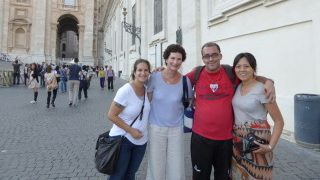
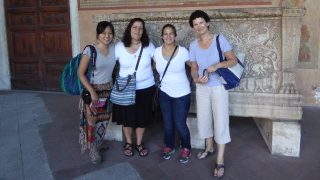
Ruth Frampton on her journey through the Seven Churches Pilgrimage (left) and during a retreat (right).
Moments of joy and spontaneity were just as formative. “I even learned to play the ukulele from a friend,” she says. “We had a ukulele band to accompany worship sometimes.” She also attended Mass in St. Peter’s Square with Pope Francis: “I was within 20 feet of him.”
Ruth’s affinity for Franciscan spirituality was reinforced during her stay. “Pope Francis communicated love in all he did,” she notes, adding that she continues to wear a simple cross, blessed by her bishop, as a symbol of her ministry.
Core Values and Lasting Impact
Reflecting on her experience, Ruth emphasizes the importance of community and hospitality. “Faith was a part of our everyday life, we lived and breathed our faith in different ways,” she shares.
“They even celebrated my birthday early and gifted me a present. That experience shaped how I welcome people into the church with love and openness.”
For those considering attending The Lay Centre, she encourages: “You will be welcomed and loved. Life can be a whirl; you’ll be swept up in activities. Go with the flow, be curious, ask questions, and learn about how others live and worship. It’s education for life, teaching mutual respect and openness.”
Looking to the future, Ruth hopes The Lay Centre continues to be a peaceful oasis, welcoming students of all faiths—and none—to experience community life. “It’s an education in itself: absorbing the beauty of Rome, its history, art, and churches, while learning about others’ faiths,” she concludes.
Photos: Ruth Frampton
Text: Regina Hernández


