
By Viktoriia Havaleshko / Photo: Karina Gandur
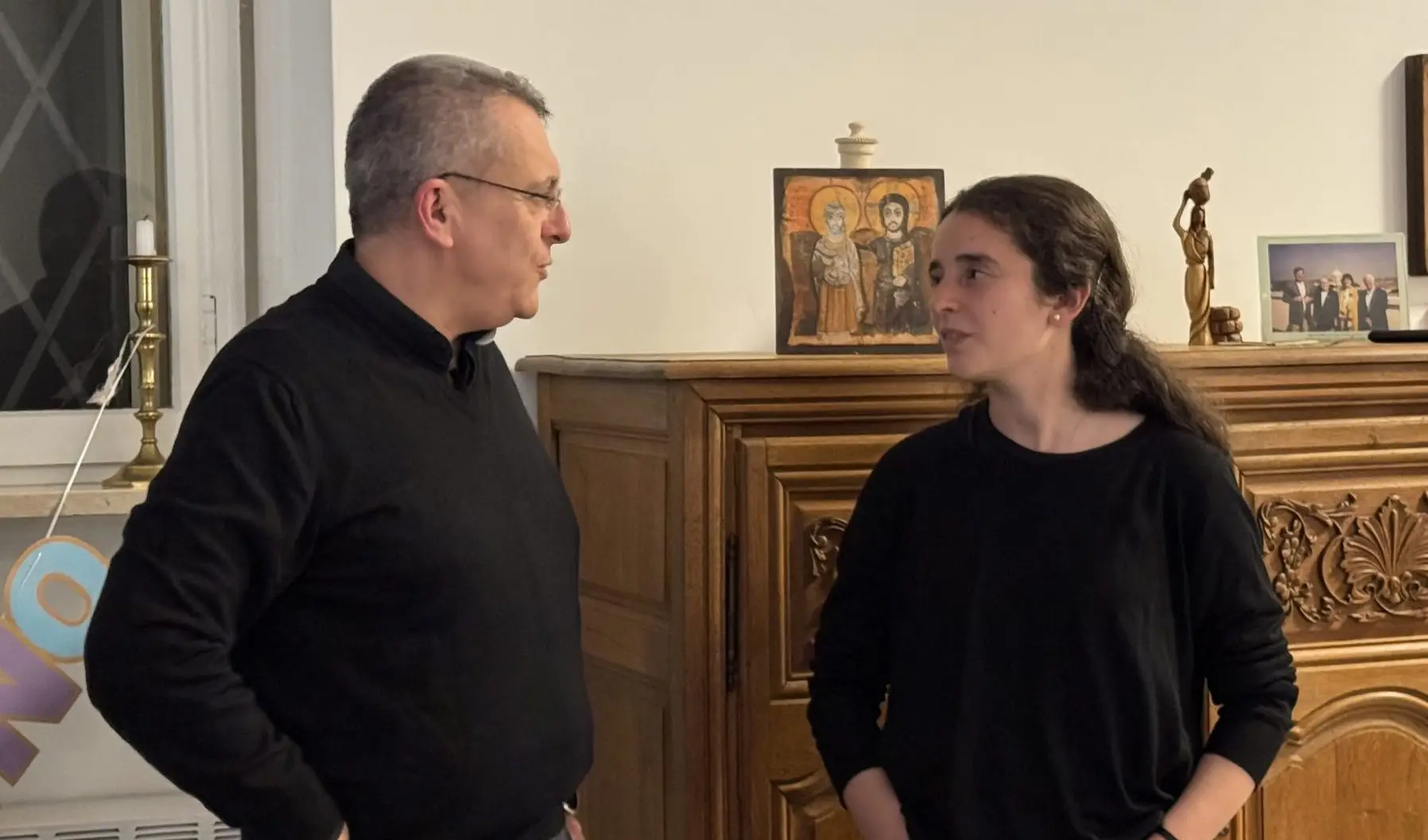
The Lay Centre community gathered during the Easter season for two separate evenings of prayer and dialogue centered on personal vocation, human dignity, and the freedom to serve within contemporary reality. On April 15, Rev. Michele Gianola, undersecretary of the Italian Episcopal Conference (CEI), joined the residents to discuss discernment, followed on April 29 by Rev. Peter Lah, SJ, Dean of Social Sciences at the Pontifical Gregorian University, who addressed human identity in the digital age.
Vocation Grounded in Identity
Don Michele, who also serves as the Director of the National Office for the Pastoral Care of Vocations for CEI, began his visit by celebrating Mass at the house before joining residents for an evening of dialogue.
Reflecting on the evening’s Gospel reading, he addressed a tension familiar to the human experience, specifically the contrast between light and darkness, hope and fear, and faith and uncertainty. He noted that Christ enters into this human vulnerability not to offer judgment, but to bring salvation, prompting residents to consider the kind of life they truly desire to live.
The discussion that followed focused on the idea that a vocation does not originate with a career choice or a structured life plan. Instead, it begins with a fundamental awareness of being a beloved child of God. Discernment, Don Michele suggested, is not an exercise in looking inward for hidden answers. Rather, it involves paying attention to the people in front of us, the responsibilities that arise, and the balance between what the world needs and what an individual is able to contribute.
Historical Witness and Modern Dignity
Two weeks later, on the Memorial of St. Catherine of Siena, Father Peter presided over the Eucharist and used the saint’s legacy to anchor his homily. He recalled St. Catherine’s distinct witness during a fractured period in the Church’s history. Despite holding no political office or hierarchical status, she corresponded extensively with popes, bishops, and rulers, famously urging the Pope to return to Rome from Avignon.
Fr. Peter used her historical example to invite the community to reflect on the interior freedom required for authentic Christian service. This historical concept of human freedom directly connects to modern discussions regarding technology and human identity. Turning to contemporary developments in artificial intelligence, Father Lah noted that while technology can replicate certain reasoning patterns, it remains a programmed system devoid of genuine human experience.
Christian faith, by contrast, is rooted in the mystery of the Incarnation. By entering history through a physical body, God affirmed the value of human embodiment and lived experience.
Human beings encounter reality not merely through abstract data or ideas, but through the unity of body, mind, and spirit. Ultimately, the human capacity to love, create, and serve cannot be reduced to mechanical processes; it remains deeply tied to personal agency and the work of the Holy Spirit.


